Ultra-Tow Hand Winches Accessories
Filters
1-9 of 9 Products

Item # 5033565
Item # 52481
Order today to get this price.
Item # 5033514
Item # 5033549
Item # 5033581
Item # 5033590
Item # 5033602
Item # 5033573
Item # 5033506
Manual Hand Winches
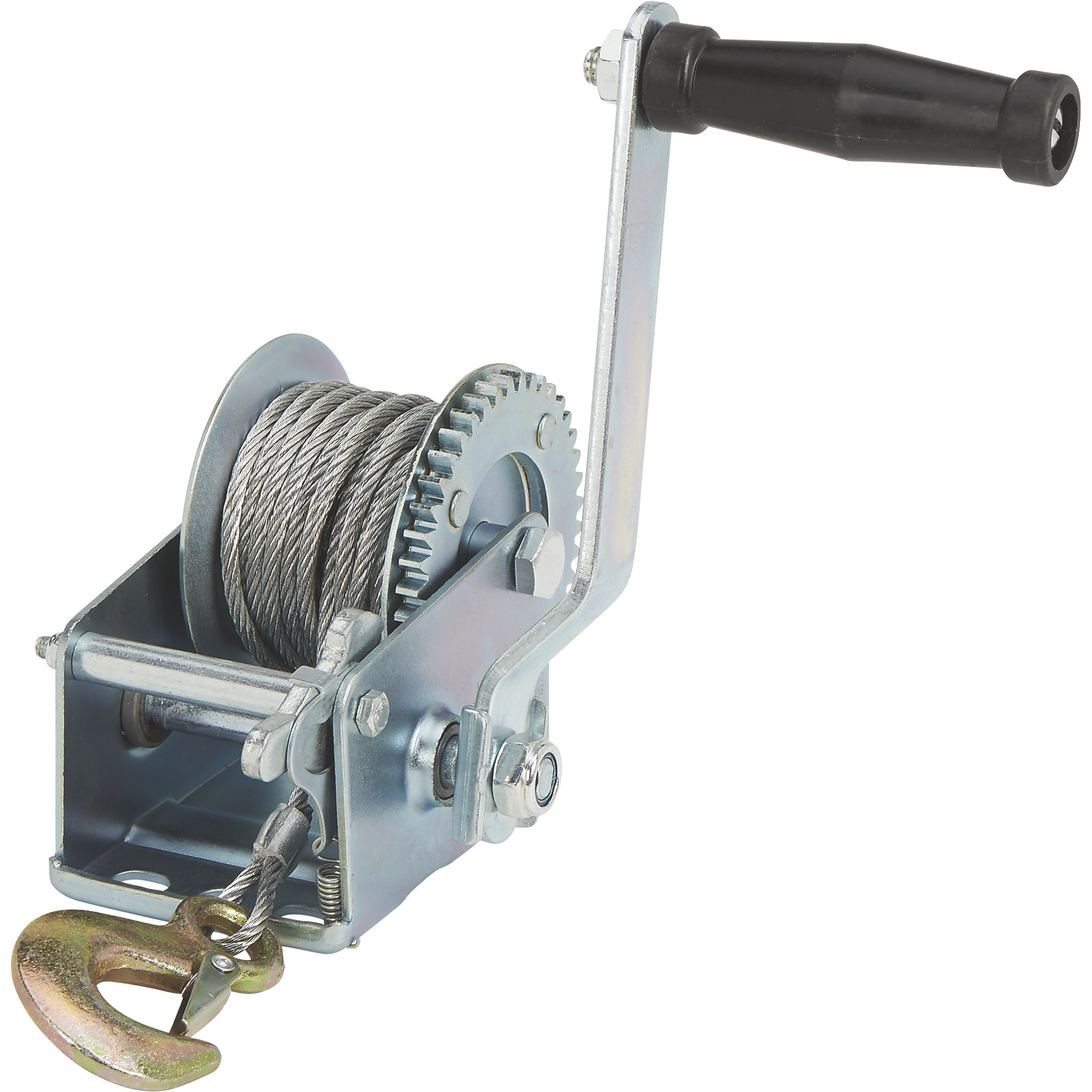
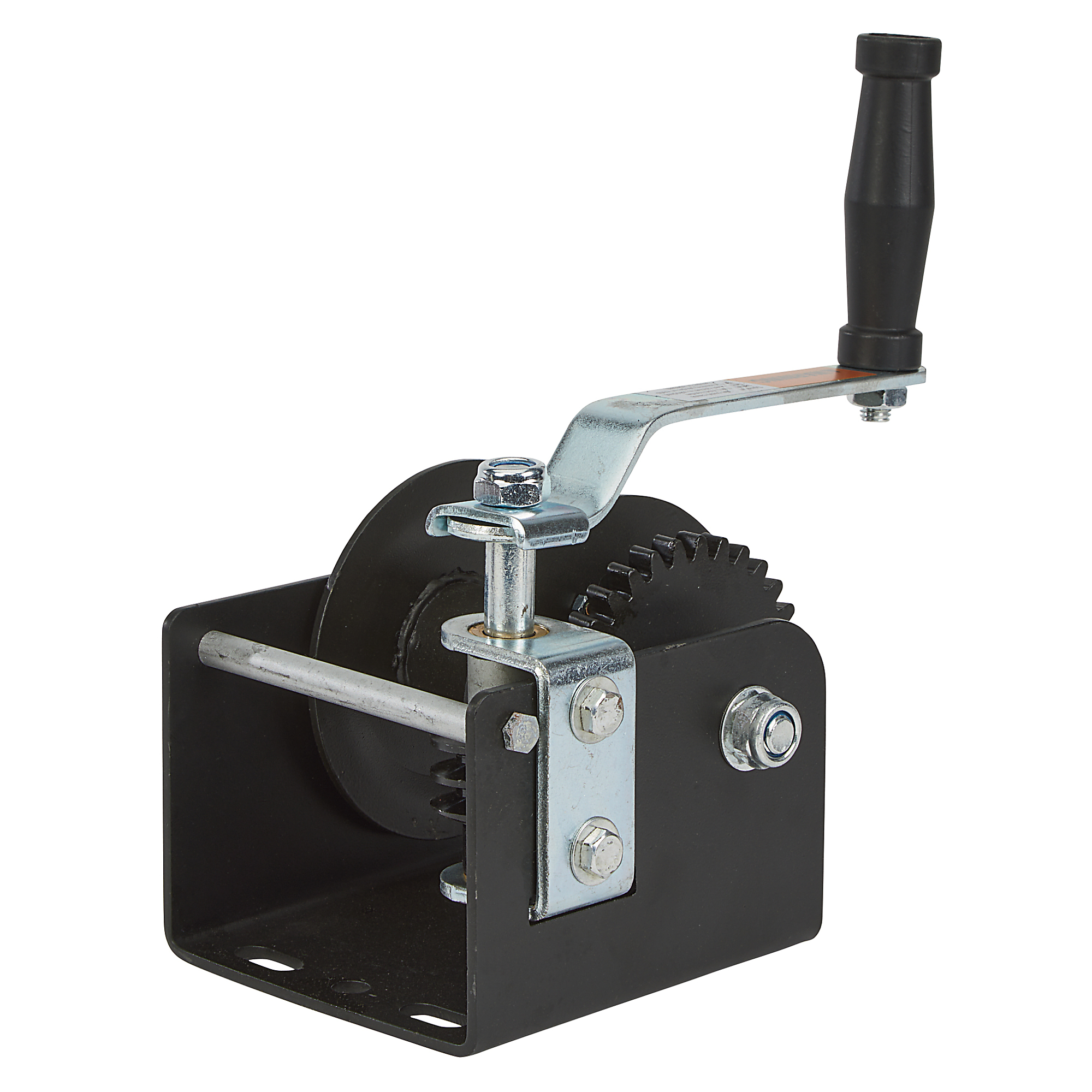
Hand winches are a great way to add more function to a trailer. Northern Tool carries a wide selection of hand winches to meet the needs of any user. Single or 2-speed ratchet-type winches are primarily designed for horizontal pulling situations, and usually have a freewheel feature that allows you to pull cable freely from the drum to attach it to the load and are not recommended for lifting applications. For inexperienced winch users, a self-locking brake winch or worm gear type winch is often a great choice to increase the safety of the hand winch operation. And if you plan on lifting or lowering items with a winch, make sure you choose a winch that is suitable for this operation style and comes equipped with a load pressure brake.
The load capacity of your hand winch will play a big part in the performance and ability of the winch to get the job done. A commonly used ratio for typical horizontal pulling situations like loading a boat onto a trailer is 2:1; that means the hand winch should have a load capacity that is at least half of what the load you will be pulling weighs (i.e., a 2000-lb. boat requires a winch with a 1000-lb. load capacity.). Hand winch accessories are also important in the lifting and pulling process. Northern Tool carries a wide selection of winch mounts, brackets, wire rope, winch straps, winch stands, and more to ensure that you get the premium performance you desire and the safety you need from your hand winch.
Hand Winches Frequently Asked Questions:
What are the key advantages of using a hand winch over other types of winches?
Although many people can’t imagine using a non-electric winch, hand winches offer some distinct advantages. Without the requirement of an outside power source, hand winches aren’t vulnerable to power cuts, so they can be used any time and any place. Hand winches are also easier to repair than electric winches because they don’t contain all the parts used to power them with electricity. All of these advantages—no outside power requirement, portability and easy repair all add up to another big advantage. Hand winches cost less to own and operate than electric winches.
What are the safety precautions one should take when using a hand winch?
It’s critical to take safety precautions before using a hand winch. These precautions include the following: • Inspecting the winch to ensure it’s in good condition prior to use. If anything’s broken, cracked or dented, it must be repaired or replaced. • Ensuring that the cable on the winch has a safety factor of 3, which means that the breaking strength of the cable must be 3X the maximum load you lift. For example, if you’re using a cable with a working capacity of 300 lbs., its breaking strength must be at least 900 lbs. • Anchoring the hand winch securely to a solid structure such as a strong tree or a rugged mounting bracket. You want to reduce the chances of sudden, unexpected movement or failure. • Wearing personal protective equipment including sturdy, puncture-proof gloves, safety goggles and stable footwear. You want hand protection that allows a strong grip, eye protection against flying debris or cable recoil and sure footing, so a small mishap doesn’t land you on the ground. • Read and follow all manufacturer’s operation instructions, so you feel comfortable using your hand winch.
Can I use a hand winch for vehicle recovery purposes?
In short, yes. Clearly, your hand winch must be in good working condition and possess the load capacity to handle the vehicle you plan to recover. More versatile than an electric winch, a hand winch can be transported to anywhere a vehicle may be stuck, and it allows you to recover your vehicle from just about any angle.
Can a hand winch be used for vertical lifting applications, such as hoisting loads?
Can a hand winch be used for vertical lifting applications, such as hoisting loads? A. The short answer is a resounding “no.” Winches and hoists are built for different purposes—a winch for pulling loads horizontally and a hoist for lifting loads vertically—and if you try to use a winch for lifting, you could experience not only a failure, but also an accident and possibly injury.