Generators Buyer's Guide
So, you are looking for dependable power for your remote cabin, your worksite, or for backup during a power outage. Head straight for the Generator Buyer's Guide to learn about common uses, how much power you will need and other information to match you up with the best generator for your needs.
Portable Generators for Emergency Power
The most economical way to supply power during a power outage is to use a portable generator of the appropriate wattage for your needs (at least 4000 Watts for starters) and run extension cords into the house to power chosen appliances. A safer system is to have an electrician install a power transfer switch, connected to the house's main electrical panel. Just fire up the generator, run a single extension cord into the transfer switch and power the circuits you need through the main circuit breaker. This eliminates the risk of electrical "back feed" injuring utility workers repairing downed power lines.
A small portable gasoline-powered electric generator can provide power for TVs, small kitchen appliances, hair dryers, power tools, lights and other comforts of civilization when you are out roughing it in the woods.
Portable generators can be put to work on construction sites that have no electrical service, providing clean, reliable power to operate circular saws, drills, air tools, air compressors, heaters, paint sprayers and other AC-powered tools. Most are gasoline-powered, a few run on diesel, and some models have multi-fuel capabilities, running on gasoline, propane or natural gas. These are generally full-featured machines with engine idle control, GFCI receptacles and 120 Volt full power switch.
Shop For Portable Generators
Home Standby Systems
An emergency home standby generator system can automatically restore power to your house in about 20 seconds. When the power goes out, the generator automatically starts and continues to run until power is restored. You can choose a generator that delivers enough power for the entire house (including air conditioning) or go with a smaller unit and power a few selected circuits, like the refrigerator, sump pump, furnace fan and several lights for basic survival.
These all-weather generators are installed outside the home and are wired through an automatic transfer switch (sold separately) to the main electrical panel. The use of an automatic transfer switch is required when generators are connected to home wiring.
Home standby systems can be fueled by natural gas, LP gas or diesel fuel. Many models can be connected to the home's natural gas line, eliminating the need to fill fuel tanks. Standby system capacities range from 6,000 Watts up to 40,000 Watts and more, and start automatically-even if you are not home.
Shop For Home Standby Systems
Commercial Standby Generators
If you have a business that simply can't be without power or you have no existing source of electrical power for your home or business, you will need an industrial generator. These are typically stationary, heavy-duty units that generate single (120 Volt) or three-phase (120, 240 or 480 Volt) power. These massive systems are powered by water-cooled diesel engines, with some models generating up to 200 KW (200,000 Watts) of power. With the use of an automatic transfer switch, these generators can serve as backup power for large commercial or industrial operations, such as nursing homes, refrigeration operations, farms, large buildings and other businesses that can't go without power due to an outage.
Shop For Commercial Standby Generators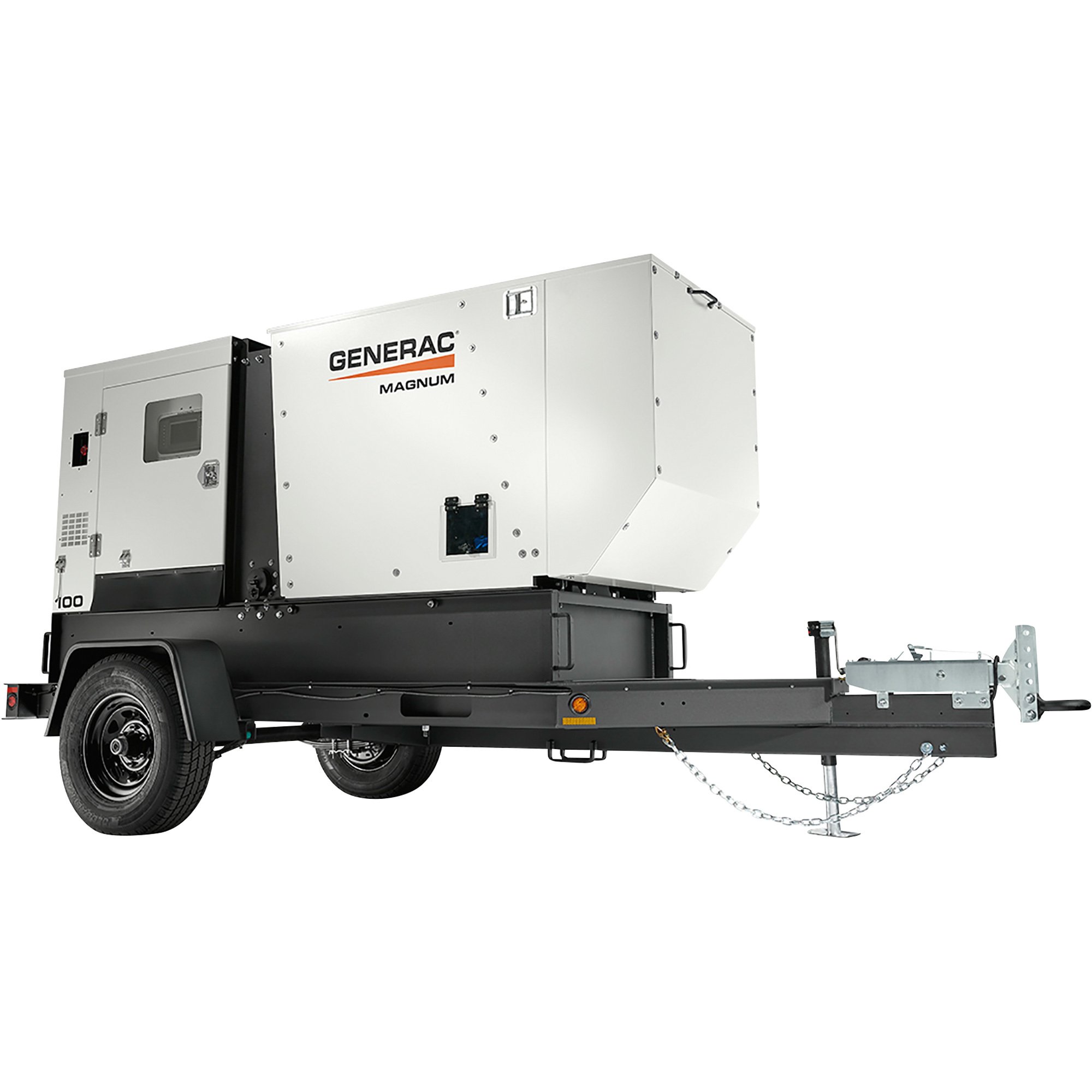
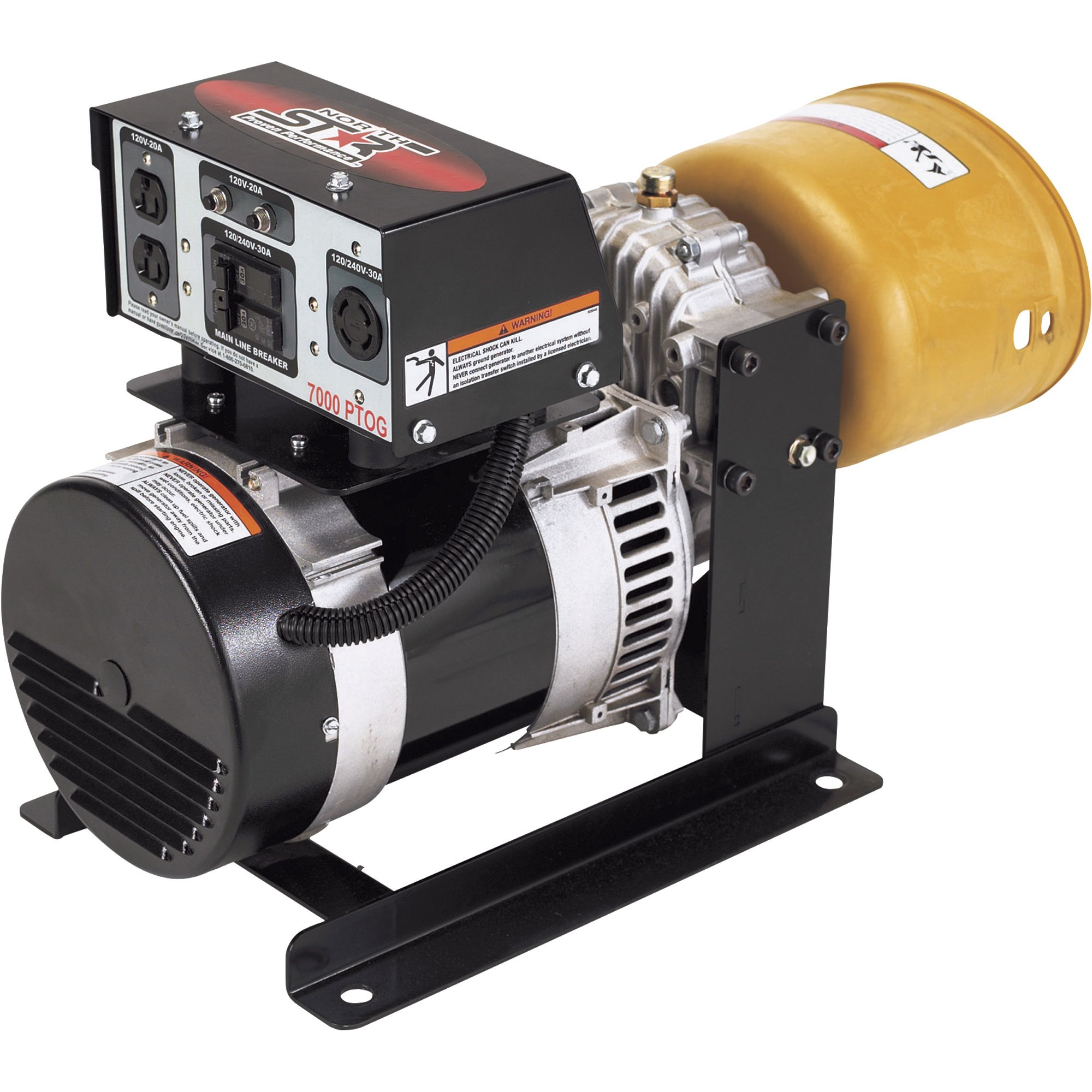
PTO and Belt-Drive Generators
Create power on demand by attaching a generator to the PTO on your tractor or construction equipment. Belt-driven generator heads work with your existing gas engines. They are less expensive because the engine is not included.
Questions You Should Ask Before You Buy a Generator
- What is the generator's wattage capacity and will it support your needs, including startup surge power required by some equipment?
- Does the generator have enough outlets to plug in all of the items you want to power?
- How noisy is the generator? Are there noise restrictions in your neighborhood?
- What type of fuel does it use?
- How large is the fuel tank and how many hours of operation will it provide?
- Is the generator easy to move around? Does it have built-in wheels and handles for portability?
- What accessories will I need to run the generator (fuel, heavy-duty extension cords, transfer switch)?
How Many Watts Will Your Generator Need to Produce?
Add up the wattage of tools, appliances and motors you want to run at the same time. Then select a generator with the RUNNING wattage rating to match or exceed the total load. Keep in mind that tools and appliances with electric motors require additional tool/appliance SURGE wattage at startup that can be double or triple the normal running wattage requirement. Look at the surge watts required and make sure you choose a generator with enough additional wattage to start them. Keep in mind that you typically are not starting more than half of the items at the same time.
Most home appliances and power tools are 120 Volts; larger appliances like electric stoves and clothes dryers may be 240 Volts. Generator power is measured in Watts: Amps x Volts = Watts
You can use our Wattage Chart to estimate the wattages of the tools, appliances and motors you will be operating at the same time. Wattage noted below are approximates only; please refer to tool or appliance itself for specific wattage required or order our easy-to-use tester below.
Wattage Chart
| Category | Appliance | Running Wattage Required | Surge Wattage Required at Startup |
|---|---|---|---|
| Household / RV | Coffee Maker | 1750 | 0 |
| Keurig Coffee Maker | 300 | 1500 | |
| Dishwasher: Cool/Dry | 700 | 1400 | |
| Electric Fry Pan | 1300 | 0 | |
| Electric Range: 8in. Element | 2100 | 0 | |
| 625W Microwave | 625 | 800 | |
| Refrigerator or Freezer | 700 | 2200 | |
| Automatic Washer | 1150 | 2300 | |
| Electric Clothes Dryer | 1800 | 5750 | |
| Furnace Fan (Gas or fuel oil): 1/8 HP | 300 | 500 | |
| Furnace Fan (Gas or fuel oil): 1/6 HP | 500 | 750 | |
| Furnace Fan (Gas or fuel oil): 1/4 HP | 600 | 1000 | |
| Furnace Fan (Gas or fuel oil): 1/3 HP | 700 | 1400 | |
| Furnace Fan (Gas or fuel oil): 1/2 HP | 875 | 2350 | |
| Lights | As indicated on bulb | 0 | |
| Single 60W equivalent CFL bulb | 15 | 0 | |
| Radio | 50-200 | 0 | |
| Sump Pump: 1/3 HP | 800 | 1300 | |
| Sump Pump: 1/2 HP | 1050 | 2150 | |
| 50in LED HDTV | 140 | 0 | |
| 50in LCD HDTV | 300 | 0 | |
| 50in Plasma HDTV | 220 | 0 | |
| RV Air Conditioner: 13,500 BTU | 1500 | 2200 | |
| Room Air Conditioner: 10,000 BTU | 1500 | 2200 | |
| Central Air Conditioner (for 2200 sq. ft. home*) | 10,000 | 11,250 | |
| Small Appliance | 200 | 1700 | |
| Contractor | 8in. Bench Grinder | 1400 | 2500 |
| Pressure Washer: 1 HP | 1200 | 3600 | |
| 7-1/4in. Circular Saw | 1400 | 2300 | |
| Electric Chain Saw: 14in. Bar, 2 HP | 1100 | 0 | |
| 10in. Table Saw | 1800 | 4500 | |
| Drill: 3/8in., 4 Amps | 440 | 600 | |
| Drill: 1/2in., 5.4 Amps | 600 | 900 | |
| Industrial Motors | Split Phase: 1/4 HP | 600 | 1000 |
| Split Phase: 1/2 HP | 875 | 2300 | |
| Capacitor Start Induction Run: 1/3 HP | 720 | 1300 | |
| Capacitor Start Induction Run: 1 HP | 1600 | 4500 | |
| Capacitor Start Capacitor Run: 1 1/2 HP | 2000 | 6100 | |
| Fan Duty: 1/6 HP | 550 | 850 | |
| Farm Equipment | Electric Fence: 25 Miles | 2500 | 0 |
| Milk Cooler | 1100 | 1800 | |
| Milker (Vacuum Pump): 2 HP | 1000 | 2300 | |
| Portable Heater (Kerosene, Diesel Fuel): 50,000 BTU | 400 | 600 | |
| Portable Heater (Kerosene, Diesel Fuel): 90,000 BTU | 500 | 725 | |
| Portable Heater (Kerosene, Diesel Fuel): 150,000 BTU | 625 | 1000 | |
| Battery Charger: 15 Amp | 380 | 0 | |
| Battery Charger: 60 Amp with 250 Amp Boost | 1500/5750 | 0 | |
| Battery Charger: 100 Amp with 300 Amp Boost | 2400/7800 | 0 | |
| Electric Welder: 200 Amp AC | 9000 | 0 | |
| Electric Welder: 230 Amp AC at 100 Amp | 7800 | 0 | |
| Computers / Devices | Desktop | 600-800 | 0 |
| Laptop | 65 | 0 | |
| LCD Computer Monitor | 25 | 0 | |
| Fax | 600-800 | 0 | |
| Laser Printer | 400 | 0 | |
| Inkjet Printer | 15 | 0 | |
| Tablet | 12 | 0 | |
| Cell Phone Charger | 10 | 0 |
*Based on average-sized unit. Central air conditioners differ in wattage requirements; consult owner's manual for specific wattage requirements.
Finally, add together the wattage requirements for all the electrical devices that you want to run, to determine the minimum continuous wattage, or start at the same time, to determine the minimum surge wattage, you will need from a generator.
Minimum Recommendations for Typical Home Standby Power (1 kw = 1,000 watts)
Typical Home Standby Power Needs
| Customer Type | Appliance | One Item at a time | Two Items at a time | All Items at once |
|---|---|---|---|---|
| Customer #1 | Lights | 2.4kw | 4.5kw | 6.6kw |
| Color Television | 2.4kw | |||
| Furnace Fan | 2.4kw | |||
| Freezer | 2.4kw | |||
| Refrigerator | 2.4kw | |||
| Sump Pump | 4.5kw | |||
| Customer #2 | Includes Customer #1 and central air | 4.5kw | 6.6kw | 10.5kw |
| Customer #3 | Includes Customer #1 and a well pump | 4.5kw | 6.6kw | 10.5kw |
| Customer #4 | All of the above | 4.5kw | 6.6kw | 13.5kw |
When in doubt, remember that bigger is better!
Safety Tips for Using Generators
- Plug appliances directly into generator
- Do not attempt to connect the generator directly to your home's circuits or wiring. Have an electrician install a transfer switch and plug the generator into this switch. This will keep the generator from feeding power back into the lines, which could put power company crews working on the lines at risk. This will also protect your generator and home wiring from damage when power is restored.
- Use heavy-duty extension cords from the generator, as overloaded cords can cause fires and equipment damage. Make sure cords are placed to avoid tripping hazards, but don't put underneath carpets where heat may build up.
- Never run a generator indoors and make sure there is proper ventilation around unit.
- Never add fuel while generator is running. Avoid spilling fuel on hot components and put out all flames or cigarettes when handling fuel.
- Consider tri-fuel generators to avoid multiple trips to the gas station and downtime.
- Always have a fully charged, approved fire extinguisher near generator.
- Don't overload the generator. Use only when necessary to power essential equipment.
- Be cautious handling electrical cords in wet conditions.
Generator Engines and Alternators: What to Look For
- Brand Name
- Choose a generator with a brand-name that you know and trust, such as Honda, Briggs & Stratton, Generac, Cummins and NorthStar.
- OHV (Overhead Valve) Engine
- OHV engines start easier, run quieter, laster and produce less emissions than side-valve (pushrod) engines.
- Cast Iron Sleeve
- The cast iron sleeve is a liner in the cylinder of some engines which reduces wear and makes the engine laster. The added cost of an engine with a cast iron sleeve is small and well worth it, if you expect to operate your generator often or for periods of time.
- Low Oil Shutdown
- This feature shuts the engine down if the oil level drops below a safe operating level, especially recommended for generators with large fuel tanks.
- Electric Start
- Enables easy starting of generator without having to pull a starter rope.
- Full Power Switch
- Allows you to switch off the 240 Volt output to get more 120 Volt power from the generator, useful for starting 120 Volt electric motors on air compressors and water pumps.
- Idle Control
- Automatically throttles down engine when no power is being drawn from alternator, reducing engine wear and noise.
- Hour Meter
- Keeps a record of how engine has run. Can help with oil change scheduling.
- Portability Kit
- Includes wheels and handles for moving the generator around. Can be a real back saver when using units that weigh over 100 lbs.
- Large Fuel Tank
- Generators with a fuel tank of 5 gallons or larger can typically run 7 to 10 hours on a single fill, useful for providing backup power during power failures.
- All-Metal Alternator
- Get an all-metal alternator because plastic housings can warp over time and cause the moving parts of the alternator to come out of alignment and break or wear excessively.
- Total Harmonic Distortion (THD)
- Total Harmonic Distortion is a means to measure the quality of electricity. 6% THD is considered the upper limit for "clean" electricity. Above 6% THD the electricity may reduce the life of electrical circuits, cause microprocessors to malfunction and cause furnace controllers to operate incorrectly. All NorthStar generators have THD less than 6%. Some generators produce THD greater than 15%.
- Brushless Alternator Design
- Brushless alternators require less maintenance and produce cleaner power that is more suitable for sensitive electronic equipment. Brush-type generators have brushes that are wear items, requiring replacement.
- Ball Bearing Alternator
- Get an alternator that uses ball bearings instead of needle bearings. It will laster.
Generator Fuel Types: What to Consider
Generators use either gasoline, diesel, natural gas or propane. Here are the advantages of each fuel type.
- Gasoline
- Most common fuel source and is easily obtained; has short shelf life
- Increases portability of smaller generators
- Propane
- Long shelf life
- Clean burning
- Easily stored in both large tanks or smaller 5-10 gallon cylinders
- Obtainable during power outages
- Home delivery available for large tanks
- Natural Gas
- Unlimited fuel source, no refilling required
- Clean burning
- Available during power outages
- Diesel
- Least flammable fuel source
- Easily obtained
- Fuel delivery available
- Battery
- Quiet
- Clean
- Interchangable battery with other tools
- Long-life lithium ion
- Solar compatible
Generator Sound: Determine Volume
Sound Intensities: How loud will it be?
Sound intensities are typically measured in decibels (db). A one decibel change is the smallest volume change detectable by the human ear. The Decibel scale is logarithmic rather than a linear scale.
How Loud is It?
| Decibels | Degree | Comparable Loudness or Feeling |
|---|---|---|
| 140 | Deafening | Jet aircraft, Artillery fire |
| 130 | Deafening | Threshold of pain, Causes immediate ear damage |
| 120 | Extremely Loud | Thunder or Diesel engine room |
| 110 | Extremely Loud | Close to a train |
| 100 | Very Loud | Wood saw, Home lawn mower, car horn @ 16 ft. |
| Over 90 decibels - Hearing can be damaged if protective equipment is not worn | ||
| 90 | Very Loud | Symphony, Truck without muffler |
| 80 | Loud | Car noise @ high speed, Police whistle |
| 70 | Loud | Normal street noise, Average radio |
| 60 | Moderate | Normal conversation |
| 50 | Moderate | Normal office noise |
| 40 | Faint | Residential area without vehicle traffic |
| 30 | Faint | Quiet conversation |
| 20 | Very Faint | Whisper, Ticking of a watch |
| 10 | Totally Quiet | Soundproof room, Threshold of hearing |
Check out our top 5 quietest generators and the best food truck generators lists.
Installation and Initial Set-Up
Cordsets + Plugs
Check out our selection of Generator Cordsets + Plugs.
| Current Power | Maximum Extension Cord Length | ||||
|---|---|---|---|---|---|
| Amps at 240V | Load (watts) | #10 Ga. Cord | #12 Ga. Cord | #14 Ga. Cord | #16 Ga. Cord |
| 10 | 2400 | 250 ft. | 150 ft. | 100 ft. | 75 ft. |
| 20 | 4800 | 125 ft. | 75 ft. | 50 ft. | 25 ft. |
| 30 | 7200 | 60 ft. | 35 ft. | 25 ft. | 10 ft. |
| 40 | 9600 | 30 ft. | 15 ft. | 10 ft. | NA |
| 50 | 12000 | 15 ft. | NA | NA | NA |
Warning
Use of undersized extension cords can cause electric shock, fire, or damage to connected devices. All extension and appliance cords must be in good condition and not worn, bare, frayed or otherwise damaged. Use of damaged electric cords can cause electric shock or fire. If an extension cord becomes hot to the touch, it is overloaded or damaged and must be replaced.
Contact Us



Text Us
Text 8002210516 for expert product support.
- Mon - Fri: 7 am - 7 pm CT
- Sat - Sun: 8 am - 5 pm CT
Message frequency varies.
Message and data rates may apply.
See our Terms & Conditions and Privacy Policy.