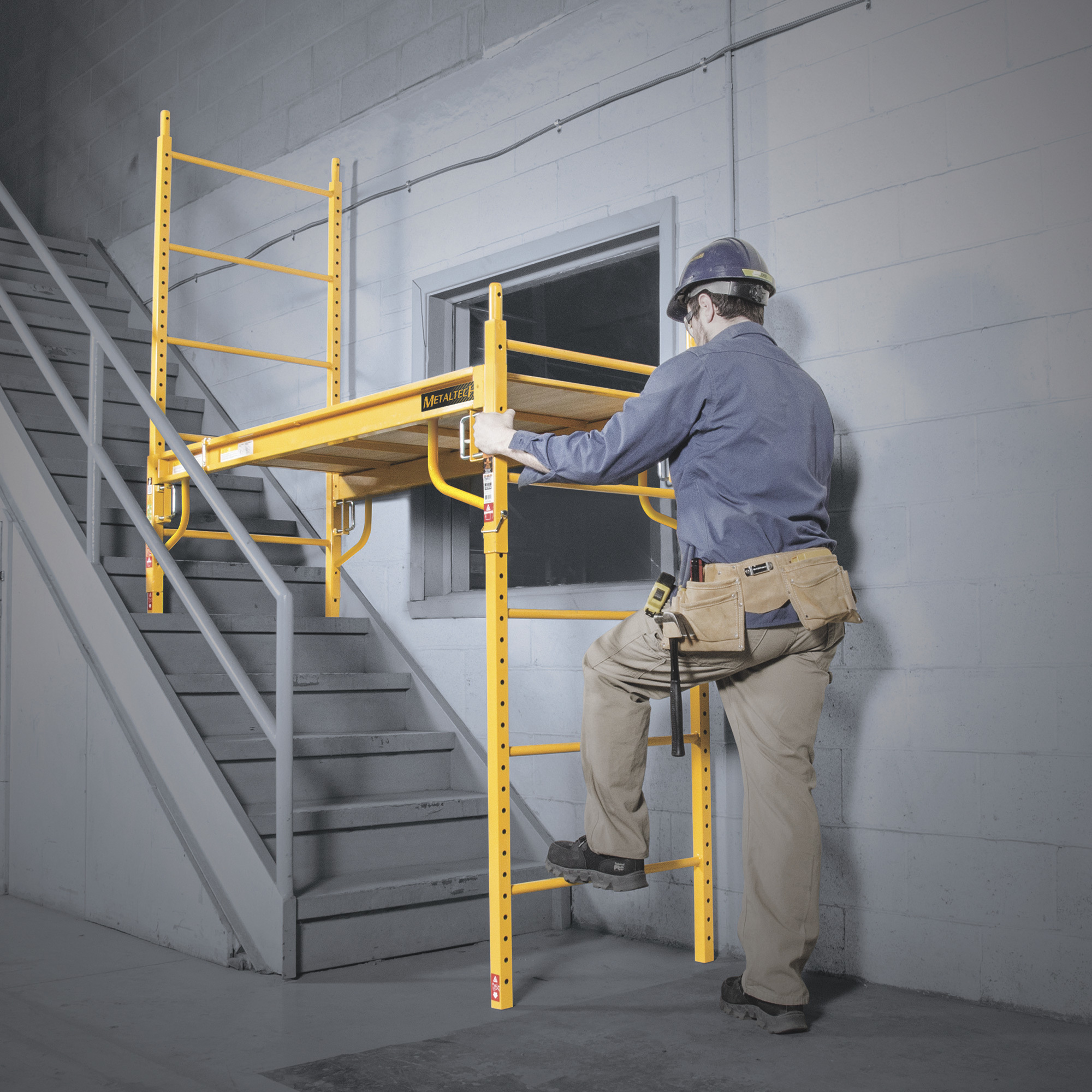
Buyers' Guide to Scaffolding: Basic Considerations
Anyone selecting and purchasing a scaffolding system soon realizes the importance of projecting, as best they can, future projects requiring its use. In choosing the right scaffolding system for your projects, some basic considerations are crucial: size, weight, working height, railing height, length, fall protection and use on various terrain. Let’s look at each in light of OSHA’s scaffolding regulations.
Scaffolding Size
A general rule by OSHA says that once a scaffold’s height is four times its minimum base dimension, it becomes unavoidably unstable and unsafe, even if it’s plumb and square. This consideration should factor in with all others: the higher your scaffold, the bigger its base must be to keep the system stable and you and your crew safe. If you choose a modular scaffolding system, you may be able to swap or add components as you need to increase your working height and thereby enlarge the size of your base.
Scaffolding Weight
Although you and your crew may not weigh much individually, OSHA’s guidelines for scaffold weight capacity greatly exceed your actual weight(s). A criterion used by OSHA is maximum intended load to assess appropriate scaffolding weight capacity. A scaffold, including all components, is required to be able to carry its own weight plus a minimum of four times the weight of workers intending to use the scaffold.
If more than one person will be on a scaffold at a time, then that scaffold’s weight capacity must be four times the weight of all workers combined. With this regulation in mind, it’s vital that you determine upfront how many people might need to be on your scaffold at a time and multiply their weight by four.
It's also important to know the exact weight of your scaffolding system, including the weight of all accessories. It’s better to err on the side of too much capacity than not enough.
Scaffolding Platform and Working Height
Assess potential projects for which you and your crew will need to be working at height. If you’re painting extra-high interior vaulted ceilings or exterior second or third stories, you’ll need a higher scaffold than someone working at less lofty heights.
Deciding on a scaffold depends on both the platform height and the working height you need to do a job. Platform height is the distance your feet need to be raised to put you in position to do your job. Working height is typically considered 6ft. beyond platform height. Working height accounts for three things: your height, your extended arm reach and the length of the tool you’ll be using. If you’re using a paint roller or brush with a long telescoping handle, your platform might not need to be as high as the platform of someone using a nail gun in the same setting simply because the nail gun handle is shorter.
Railing Height: Top and Midrails
If your platform is 10ft. high or higher, OSHA requires that you be protected by a guardrail or personal fall arrest protection. Prior to January 2001, OSHA’s minimum height was 36 inches, but since then the minimum is 38 inches, and the maximum is 45 inches. The idea behind the height minimum and maximum of the top rail is that it encompasses the center of gravity for most adults. Midrails, the middle bars in the railing, are critical, too, for ensuring that a worker doesn’t fall through the bars of the railing. According to OSHA, the midrail should be positioned between 20 inches and 30 inches above your work platform.
Scaffold and Platform Length
Your scaffold and platform length should be determined by how much working space you need to perform your job. A rule of thumb: get the maximum length you think you’ll need for present and future projects. If you want to be able to work a wide swath, obviously the longer the scaffold and platform you choose, the more work you can do without moving your scaffold.
According to OSHA, if your platform is 10 feet long or less, it should not extend beyond its support by more than 10 inches unless it’s made and attached so the cantilevered section can support crew and supplies without tipping, or if it has guardrails blocking crew access to the cantilevered end. If your platform is longer than 10 feet, it shouldn’t extend beyond its support by more than 18 inches unless it’s made and attached so that its cantilevered portion can hold employees and supplies without tipping or has guardrails blocking crew access to the cantilevered end.
Personal Fall Arrest Protection
Persons using a 1-point or 2-point adjustable suspension scaffold must be protected by both guardrails and a personal fall arrest system tied to a secure, high-capacity support separate from the scaffold itself. For some other types of scaffolding, personal fall arrest protection may be used instead of a rail system.
Scaffolding Use on Various Terrain
If you’ll be working outside at height, and you won’t be on even terrain such as a concrete pad, chances are the terrain will be uneven, and you’ll need to level your scaffold. You’ll want to check out a number of accessories designed for leveling scaffolds to ensure a safe workspace.
These accessories include adjustable components; leveling jacks, plates or wheels; or outriggers. Even if you use a leveling accessory on soft, uneven terrain, you might want to use a set of hardwood blocks, all the same size, to put under each leg to prevent it from sinking into soft terrain.
For Further Information
To ensure that the scaffolding you purchase complies with OSHA safety rules, check out the OSHA website.