Metaltech

Frequently Asked Questions
General Questions
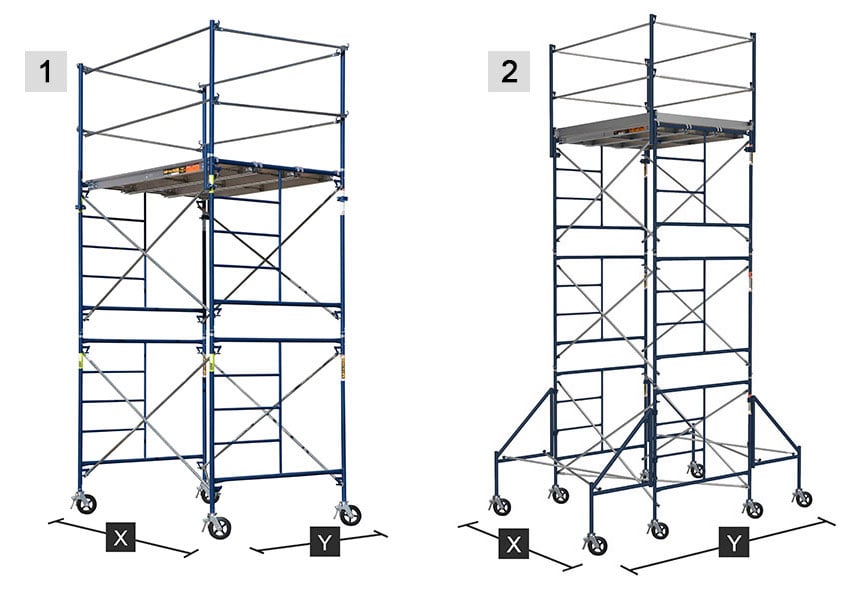
This ratio is given by standards: CSA, ANSI, OSHA. This ratio changes depending on the region in which the scaffolding is used. It gives the maximum platform height depending on the width of the smallest base. Without anchoring, the platform height must not exceed 3x (or 4x depending on the applicable standard) the width of the smallest base.
For example: On figure 1 below, the width of the smallest base is Y. So, without anchor, the maximum platform height is 3 x Y (or 4 x Y, depending on the region).
On figure 2, the width of the smallest base is X. So, without anchor, the maximum platform height is 3 x X (or 4 x X, depending on the region).
There is no lifespan because each user has their own way of using and maintaining their equipment. However, the assembly instructions and standards must be respected.
An inspection must be done before each use.
Equipment inspection instructions are available in the assembly instructions or on Metaltech's website under the product's heading.
The warranty of all Metaltech products is 1 year. For more information, see Metaltech's Warranty Information.
The warranty does not cover damages caused by improper maintenance, abuse or modification of the product.
ANSI and OSHA standards say that a guardrail is mandatory when the platform height is 10ft. (3m) or more. The CSA standards say that a guardrail is required if the platform height is 8ft. or more. (The height may change depending on the applicable standard).
Different standards may apply in different regions. Always respect local standards.
Metaltech recommends the use of a guardrail even for work under 8ft.
The height depends on the standard which applies.
According to ANSI and OSHA standards, fabricated frame scaffolding of 125ft. (38m) or higher, measured from the base, must be designed by an engineer.
According to the CSA standard, fabricated frame scaffolding with a height of 49ft. (15m) or more, measured from the base to the highest deck, must be the subject of design plans prepared by an engineer.
According to the CNESST, the installation of fabricated frame scaffolding over 60ft. (18m) high must be designed by an engineer.
Exterior Scaffolding Questions
No, you cannot climb on the cross brace.
All Metaltech frames and arches with their uprights having an outside diameter of 1.69in. or 1.625in. are compatible with the leveling jacks whose codes start with M-MBSJ.
The light-duty frames, those whose codes start with LD-LD and whose uprights' outer diameter is 1.25in. are compatible with the leveling jack LD-LDBJP24.
The M-MF60EPS frame can be locked at 36in. or 60in. wide. It cannot be locked between these 2 positions.
The maximum distance between 2 wall brackets is 10ft. (3m) center to center.
Interior Scaffolding Questions
Yes, a guardrail must be installed.
Standards say that a guardrail is required if the platform height is 8ft. or more for CSA standard and 10ft. or more for ANSI and OSHA standards (this value can change depending on the local standards).
Metaltech recommends the use of a guardrail even for an I-CISC without its extension, even if standards do not require it.
Yes, it is possible to stack up to 3 units 1 on top of the other.
When stacking 2 units, a guardrail (I-CISGRJP) and the 14in. outriggers (I-CISO4) must be installed. When stacking 3 units, a guardrail (I-CISGRJP) and the 46in. outriggers (I-BMSO4TT) must be installed.
Yes, you just have to adjust the braces that support the platform, so it is horizontal. Each end can adjust separately every 2in. to be used in stairways. Remove casters when using on stairs.
No, this tower contains platform without a trapdoor.
These leveling jacks are used with interior scaffolding. They are compatible with:
I-CISC, I-BMSS, I-CAISC, I-CISCTP, I-CISCAS, I-CISCH1 and I-CISCDW.
No, these 2 scaffolds are not compatible.
For the 6ft. Baker (I-CISC, I-BMSS, I-CAISC) and 6ft. (I-IRC, I-BM6S) scaffoldings, yes, you must use the rungs of the frame. If the scaffolding has a platform with a trapdoor, you have to climb from the inside of the scaffold. If the platform does not have a trapdoor, climb from the outside of the scaffold while respecting the "maximum climbing distance" table in the assembly instructions. You can find the assembly instructions on Metaltech's website under the product's heading.
For the 6ft. (I-CAIRC), 5ft. (I-IMIS) and 4ft. (I-IMCN, I-BM4S, I-IMAC) scaffoldings, no, you cannot use the rungs to climb up or down the structure. You have to use the platforms.
No, the doors must always be closed when you are on the platform. By closing the doors, we avoid falls, and it adds rigidity to the guardrail's structure.
No, the doors must always be closed when you are on the platform. By closing the doors, we avoid falls, and it adds rigidity to the guardrail's structure.
Yes, the Jobsite Series 6ft. Baker (I-CISCDW) have 6in. casters. The Buildman 6ft. Baker (I-BMSS) also have 6in. casters while having a higher capacity.
These 2 models of outrigger have different casters. The casters of the outriggers (I-CISO4) have a square stem, while the casters of the Perry style outriggers (I-CISO4PY) have a round stem. These casters are not interchangeable between the 2 different models of outrigger.
The Jobsite Series 6ft. (I-IRC) is stackable. It can be stacked 2 units high, 1 on top of the other. When stacking 2 units, guardrail (I-IRGR) and outriggers (I-IRO4) must be installed.
The Jobsite Series 5ft. (I-IMIS) & 4ft. (I-IMCN) are not stackable. Use only 1 unit high.
Yes, the scaffoldings Jobsite Series 6ft. Baker (I-CISCH1, I-CISCAS) have anti-slip platforms.
Yes, the Buildman Grade has a higher capacity than the Jobsite Series.
Yes, the Alu Series, made of aluminum, is lighter than the Jobsite Series which is made of steel.
Yes, it is possible to stack 3 units 1 on top of the other.
When stacking 2 units, a guardrail (I-CAISCGR) and the 14in. outriggers (I-CAISO4) must be installed. When stacking 3 units, a guardrail (I-CAISCGR) and the 46in. outriggers (I-BMSO4TT) must be installed.
No, the mobile scaffoldings 4ft. Jobsite Series only come with 4in. diameter casters.
You can ride approximately 4,500 linear feet with the Climb-N-Go. Many factors can impact the distance of a battery charge: the battery voltage, the Ah, the brand, the age of the battery, the speed that the user is setting on the Climb-N-Go and the ground surface. Based on tests that were performed with a 20 Volt battery, 4 Ah, it can ride from 4,500ft.–5,800ft.
No, outriggers cannot be installed with the Climb-N-Go.
Yes, the Climb-N-Go complies with the OSHA standards.
There is an automatic wheel locking system on the Climb-N-Go wheels. When the motor is not on, the wheels are automatically locked.
The Climb-N-Go is designed to be used on even ground. We do understand that no ground is perfect, but to comply with OSHA standards the Climb-N-Go must be used on a floor that has a 3° maximum slope.
No, the Climb-N-Go can only move on a 360° span. To reach higher levels you will need to manually lift your Baker to the desired height.
The Climb-N-Go was built to be used and was tested solely on Metaltech Bakers. We do not recommend using on another scaffolding brand.
Yes, the Climb-N-Go can be powered and was tested with the DEWALT's 20V/60V Flex battery. This battery can power a product that needs a 20V or a 60V battery. In the case of CNG it works as a 20V battery.
Yes, if you are working on a flat surface.
No, the motor was not built to be resistant to water.