JET Bottle Jacks
Filters
1-6 of 6 Products

Item # 61116
Item # 88702
Item # 7227021
Item # 106410
Item # 7231661
Item # 7231792
Bottle Jacks
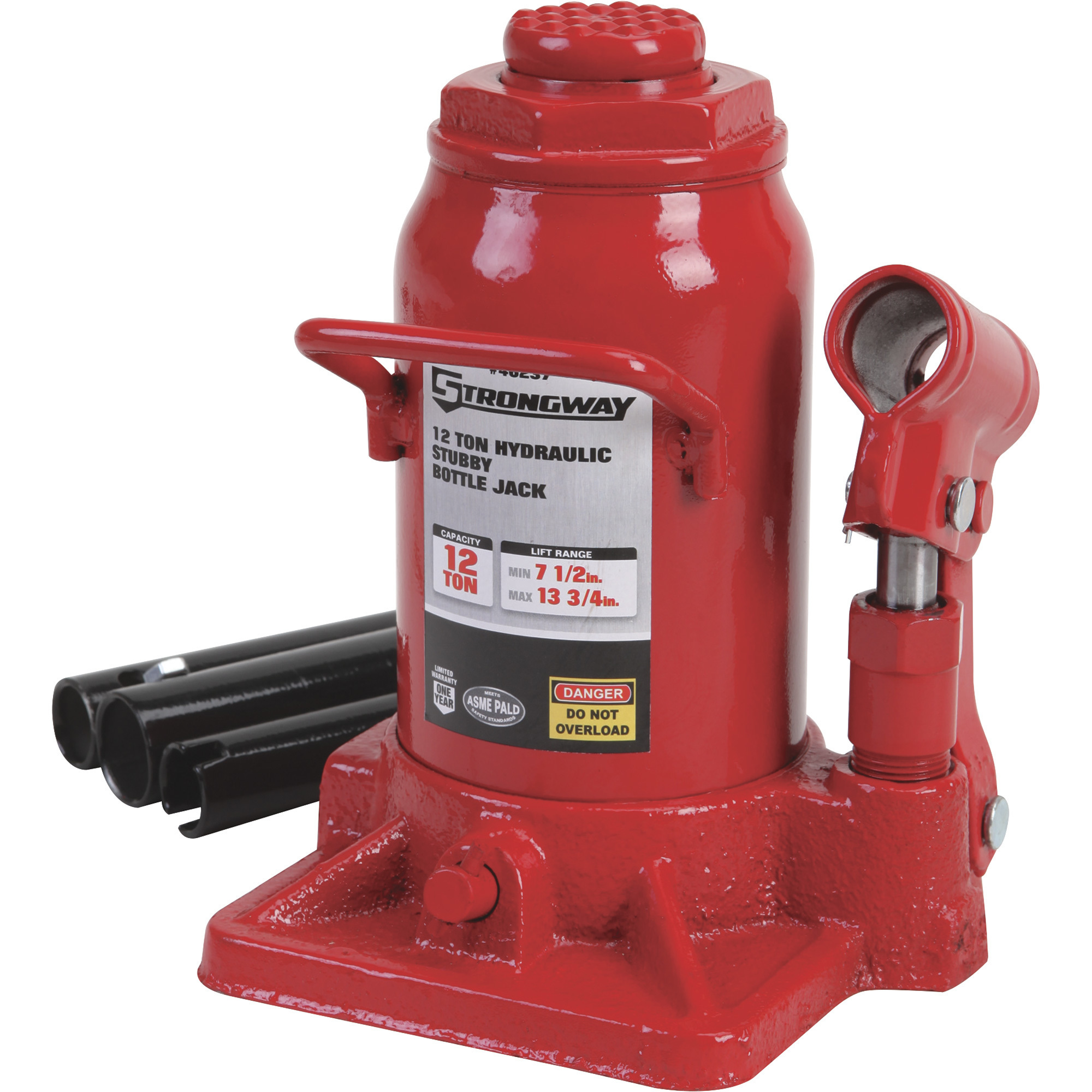
Virtually everyone who owns a vehicle or works on one owns a jack in one of two designs: a floor jack or bottle jack. Both designs have the same basic function, which is simply to lift your vehicle for maintenance and repairs. And both styles have their benefits but the bottle jack offers a few distinct advantages over the floor jack design that make them a very popular choice among professionals and do-it-yourselfers.
First of all, bottle jacks are generally more affordable than floor models, which can be the ultimate deciding factor for consumers on a budget. Another key advantage for bottle jacks is that they are more compact, making them easier to handle and allowing you to more easily store them away in your vehicle. This can be especially important in the event of a roadside emergency. While bottle jacks are effective, easy to use solutions in most situations, there are a couple of disadvantages. Bottle jacks are not considered as stable as floor models and have a higher minimum lift range, which can be a limiting factor for those with low-clearance vehicles.
When shopping for a bottle jack, you will see that they are available in a wide range of lifting capacities from 2 tons to 50 tons and vary in lift ranges from just over 5in. to over 23in. The lifting operation of bottle jacks include air, hydraulic or a combination of air/hydraulic. Northern Tool + Equipment carries a full selection of top-quality bottle jacks from leading brands, including Strongway, Yellow Jacket, Blackhawk Automotive, Pro-Lift, Sunex, Safeguard and more.
Be sure to browse the Best Bottle Jacks list which reveals our customer's favorites.
Bottle Jack Frequently Asked Questions:
How do I choose the right size and type of bottle jack for my specific needs?
Some major features need to be considered when choosing a bottle jack.
It’s important to choose a unit with the capacity to accommodate the weight ranges of the vehicles you plan to use the jack on. A 2-ton bottle jack can lift most cars and small SUVs, while a 3-ton jack can handle most trucks and full-size SUVs. You’ll want to be sure that the bottle jack you choose offers a capacity that meets or exceeds the weight of the heaviest vehicle you plan to lift with it.
Also critical to your choice of a bottle jack is its lift range. Both minimum and maximum lift height are important. The minimum lift is the lowest height of the jack. The maximum lift range is the height of the extended jack, or the height a load can be lifted from the ground surface. How high do you want to be able to lift a vehicle? Be sure your bottle jack offers that capacity, in addition to a minimum height that accommodates your intended uses.
What are the weight capacity options available for bottle jacks?
Bottle jacks are available on the market with weight options ranging from 2 tons up to 50 tons.
What are the main differences between hydraulic bottle jacks and mechanical bottle jacks?
Hydraulic bottle jacks deliver greater force with less manual effort than manual jacks. Accordingly, hydraulic bottle jacks are more efficient for heavier loads, while manual bottle jacks work well for lighter loads.
Are there any maintenance requirements for bottle jacks?
It’s important to bleed air bubbles from your bottle jack on occasion. To do so, push the handle release and twist it counterclockwise two full turns from the closed position. Next, place the handle in the operating lever and pump it until it reaches maximum height. Air should purge during this process and your jack should operate well. (You may need to repeat this process to ensure all air bubbles have been released.)
It's also important to keep sufficient oil in your bottle jack. To check oil, ensure that the head cap is completely lowered. Next, locate and remove the air vent plug. Check to see that oil sits level at the bottom of the valve hull. If oil is low, add oil and close the air vent plug. Be sure to use only good-grade hydraulic oil. To avoid serious damage to your bottle jack, avoid mixing oils or using any other fluid other than hydraulic oil.
In addition, it’s important to lubricate all moving parts of your bottle jack occasionally, including joints, hinges and the handle base. Again, refrain from using anything other than a good grade of oil for the working parts.
In preparation for storing your bottle jack, find a clean, dry place, preferably indoors, for protection from moisture.
Avoid repairing or modifying your bottle jack yourself. Instead, take it to a repair center certified to work on it. Otherwise, your warranty will be cancelled.
Are there any limitations or restrictions on the materials or surfaces that bottle jacks can be used on?
There are two surfaces to consider when using a bottle jack: the surface of the vehicle you are lifting and the surface of the area where the bottle jack will stand during use. It’s critical to lift only on areas of a vehicle designated by its manufacturer. That said, be sure to check those areas for damage, corrosion or moisture or oil. Anything that causes a slick surface could lead to a vehicle slipping while lifting. Bottle jacks should always be positioned on a hard, level surface such as a concrete pavement or garage floor. Never try to use a bottle jack on unstable ground.
Another critical consideration: never use a bottle jack around moving vehicles or other potential hazards.